
Most automatic litter boxes are designed for a very specific kind of multi-cat household. The kind where two reasonably sized cats use the box in polite rotation, generate a manageable amount of waste, and generally behave as if they read the product spec sheet. Let’s be honest: that is not most multi-cat households.
In a home with three or more cats, especially larger ones, the math changes fast. A waste drawer that works fine for two cats needs emptying every day or two with four. Litter levels drop faster than most boxes can compensate for, because most boxes do not compensate at all. The dome that looked roomy in the product photos starts to feel considerably less roomy when a 20-pound cat is trying to turn around inside it. The gap between “designed for multi-cat homes” and “actually built for them” is, frankly, substantial. Most boxes live quietly in that gap.
The HomerunPET CS106 is a direct attempt to close it. The 106-liter dome is the largest interior currently available in any automatic self-cleaning litter box on the market. The 12-liter waste bin is similarly outsized. An auto-refill system monitors litter depth and adds more from a built-in reservoir before levels drop low enough to become a problem. None of this is marketing language. The size is real, the capacity is real, and the auto-refill works. The trade-offs are real too, and worth knowing before purchasing.
Editor Note: Trusted Pet Review may earn a commission on qualifying purchases made through links in this post, at no extra cost to you. We only recommend products we’d genuinely consider for our own pets.
Most automatic litter boxes describe themselves as multi-cat solutions. This one is actually built like one. The difference between those two things is the entire review.
What the HomerunPET CS106 Is
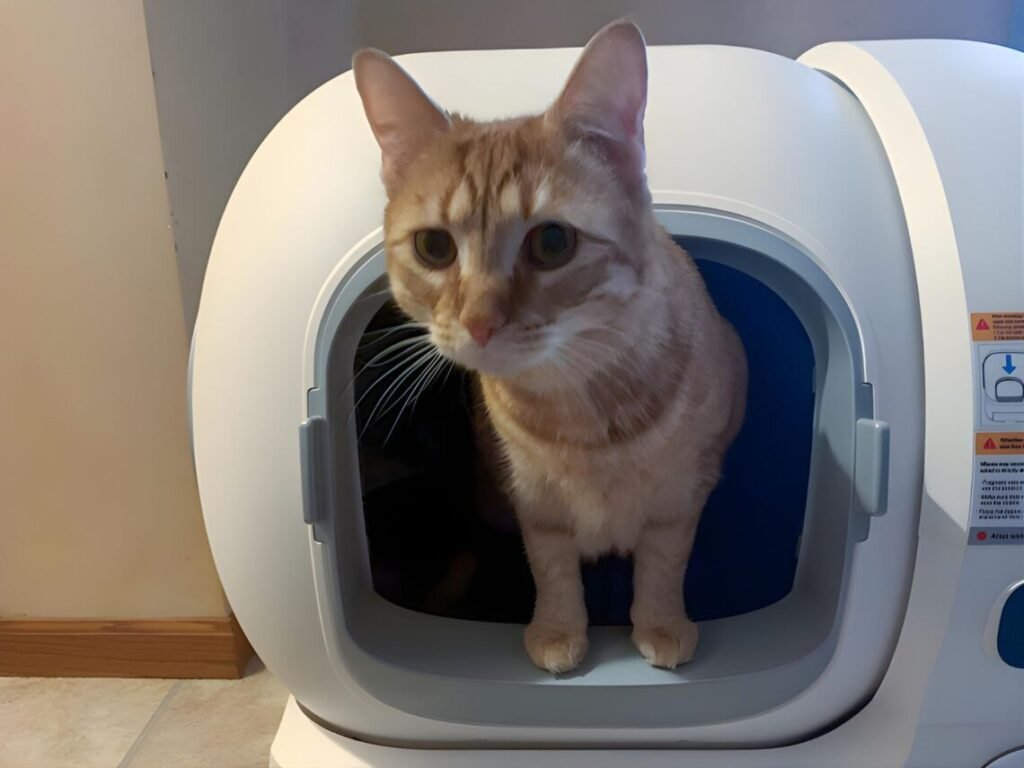
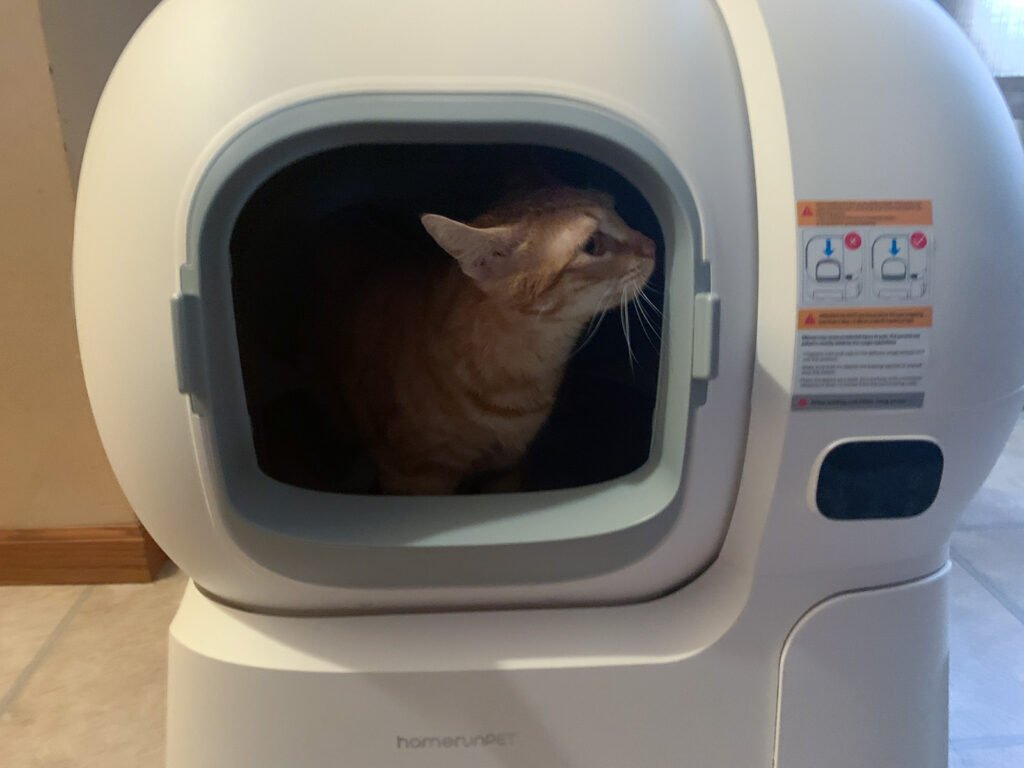
Think of it as the automatic litter box category finally catching up to what multi-cat households actually need. The CS106 is a globe-style self-cleaning unit with a 106-liter dome, spacious enough for cats up to 25 pounds to turn, dig, and use the box without the experience of, as real-world owners have described it, an airplane bathroom. That framing is apt. Standard automatic litter boxes sized for average cats do not leave much margin for larger breeds or heavy-bodied cats. This one does.
The 12-liter waste drawer is, by a meaningful margin, one of the largest in the category. That margin matters more in practice than it does on a spec sheet. In a three-or-four-cat household, a smaller drawer requires emptying every couple of days to stay functional, which starts to undercut the entire point of automation. More capacity means more runway between maintenance sessions. That is the core practical argument for this box, and it holds up.
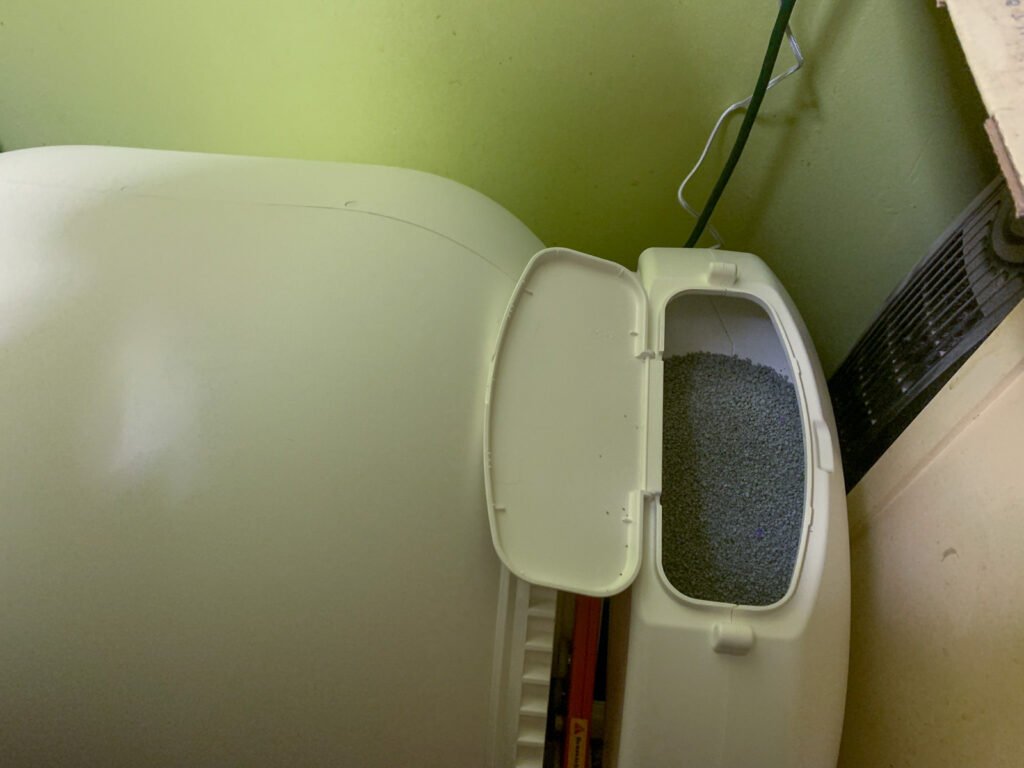
The auto-refill system is what genuinely separates it from everything else currently available. A TOF laser sensor monitors litter depth, and when levels drop below the six-liter threshold, the unit draws from a separate reservoir and adds more automatically. FYI: the sensitivity is adjustable through the app, and the system can be disabled entirely for manual control if preferred. For a household where the box sees heavy daily use, the difference between a system that manages its own litter levels and one that quietly runs low until someone notices is, frankly, not a small thing.
HomerunPET CS106 at a Glance
Best For | Large cats (up to 25 lbs) and multi-cat households of three or more |
Dome Capacity | 106 liters — largest interior currently available in an automatic litter box |
Waste Bin | 12 liters — one of the largest waste drawers in the category |
Auto-Refill | TOF laser sensor triggers automatic litter addition when levels drop below 6L |
Noise Level | Rated 38.8 dB — quiet enough for placement near living spaces or bedrooms |
Safety System | Radar entrance sensor + 4 base weight sensors + anti-pinch dome gap |
Litter Types | Clay clumping, tofu, and mixed tofu-clay blends |
App Required | No — touch panel operates full functionality without app connection |
Dimensions | 27.44″ L x 23.62″ W x 28.07″ H |
Weight | 44 lbs — plan placement before setup; requires two people to position |
Trial / Warranty | 90-day in-home trial; 12-month warranty |
Not Suitable For | Kittens under 3.3 lbs; senior cats with mobility limitations may need a step |
How It Works
The Space Question
The dome interior is the most immediately noticeable difference between this and every other automatic litter box currently on the market. Competing globe-style boxes with standard sizing accommodate average-weight cats adequately. For cats in the 15-to-25-pound range, that sizing becomes noticeably tighter. The CS106 provides enough interior volume that larger cats have room to position themselves naturally, which matters for both comfort and consistent litter box use.
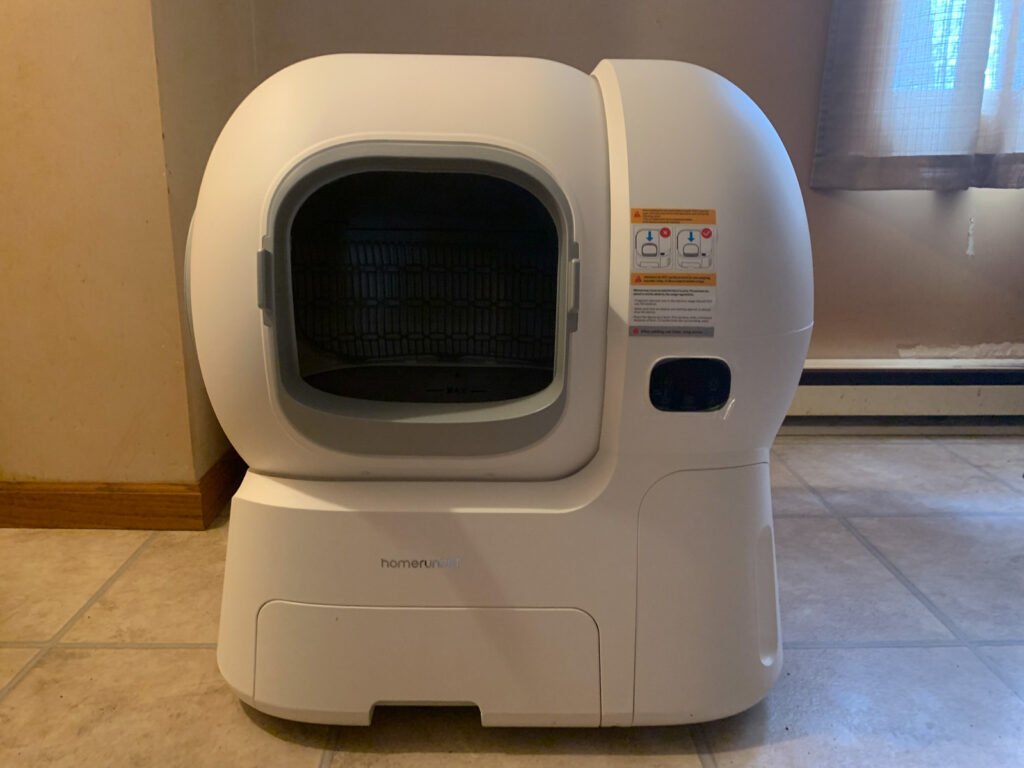
The footprint on the floor is larger than most competitors, but not dramatically so. The unit is taller than it is wide. In practice, the primary space consideration is height clearance and depth from the wall, not floor area. That said, plan the placement before assembly. At 44 lbs, repositioning after the fact requires two people and some effort.
The Auto-Refill System
This is the feature most worth understanding before purchasing, because it changes the maintenance math for multi-cat households more than any other spec. The litter reservoir sits adjacent to the dome. The laser sensor monitors depth inside the cleaning area continuously. When levels fall below the threshold, the system tops it off automatically. The manufacturer states up to 14 days between manual refills depending on cat count and usage volume. In households with three or four cats, that figure will vary, but the principle holds: litter maintenance becomes periodic rather than daily.
Sensitivity can be adjusted through the app if the unit is adding litter too frequently or not frequently enough for a specific household. The system can also be switched off entirely and refills handled manually, which suits owners who prefer direct control over the automated approach. Neither option requires a subscription or premium app tier.
Safety Features
The safety system runs on three independent layers. A radar sensor positioned near the dome entrance detects approach and halts the cleaning cycle before entry. Four weight sensors embedded in the base detect when a cat is inside the dome. The dual-bump anti-pinch design prevents the dome from fully sealing at any point in the cycle, leaving a continuous escape gap regardless of where the rotation stops. Any one of these would constitute a reasonable safety system. The combination provides meaningful redundancy for households with curious or unpredictable cats.

Pro Tips
Weight sensors require a hard floor surface to register accurately. On carpet, sensor calibration is unreliable and safety detection may be compromised. If the intended placement is a carpeted room, a hard mat or platform under the unit is worth adding before first use.
Noise Level
The 38.8 dB rating is accurate in practice. The cleaning cycle produces soft litter movement against the dome walls. Motor noise is not audible from a normal distance. For comparison, a quiet conversation registers around 60 dB. At 38.8 dB, the CS106 sits closer to the ambient noise of a quiet room than to anything that would disturb sleep or conversation.
This matters more than it might seem for placement decisions. A box that runs at 50 or 55 dB limits where it can realistically live in a home. This one does not carry that restriction.
Litter Compatibility
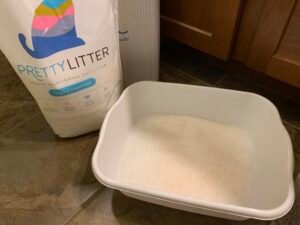
The CS106 works with traditional clay clumping litter, tofu litter, and mixed tofu-clay blends. That flexibility is worth noting for households that have already found a litter their cats will consistently use. Introducing a new automatic litter box is typically enough of a transition without also requiring a litter change. The broader compatibility range means the box can adapt to an existing routine rather than requiring the household to adapt to it.
Weight and Stability
At 44 lbs, the CS106 is heavier than every other automatic litter box currently on the market. That weight is genuinely inconvenient during initial setup and impractical for frequent repositioning. It is, however, the reason the unit does not move. Larger cats that exit a litter box with momentum can knock lighter units out of position, triggering placement errors and interrupting cleaning cycles. The CS106 stays where it is placed. For households with heavy-bodied or high-energy cats, that stability is worth the setup inconvenience.
The manufacturer recommends assembling the base in the final location first, then adding the dome and reservoir components in place. That approach reduces the need to move the fully assembled unit after the fact.
- Largest interior in the category The 106L dome is spacious enough for cats up to 25 lbs to turn and dig without restriction. Genuinely the most room available in any automatic litter box currently on the market.
- 12L waste bin One of the largest waste drawers available. In a three-or-four-cat household, meaningfully fewer emptying sessions compared to standard-capacity competitors.
- Auto-refill system Monitors litter depth via laser sensor and adds more from a built-in reservoir before levels drop low enough to become a problem. Adjustable sensitivity; can be disabled entirely.
- Ultra-quiet at 38.8 dB Soft litter movement is audible. Motor noise is not. Appropriate for placement near living spaces or bedrooms without disrupting the room.
- Heavy stable base At 44 lbs, the unit does not shift when larger cats exit. A genuine practical advantage for households with high-energy or heavy-bodied cats.
- Multi-layer safety system Radar sensor at the entrance, four base weight sensors, and a dual-bump anti-pinch design that prevents the dome from fully sealing. Stops immediately on detection.
- Fully operable without the app Touch panel controls handle cleaning cycles, resets, and emptying. The app adds tracking and granular control; it is not required for core functionality.
- 90-day in-home trial Meaningful return window for a product this size. Enough time to assess real-world fit across litter type, cat size, and household volume.
- 44 lbs is not casual weight Positioning requires two people. Once placed, it stays placed. Plan the location before setup, not after.
- Filter swap is awkward The refill mechanism partially obstructs access to the filter housing. Reaching it requires a full arm extension into the dome. That said, the swap is infrequent enough that it is more of a one-time inconvenience than an ongoing frustration.
- Initial app pairing is manual The app does not automatically detect the unit on first connection. Manual pairing adds a few steps upfront. Once paired, it functions without issue.
- Entrance height may not suit all senior cats The opening sits higher than lower-profile competitors. A step or platform resolves this, but it is worth planning for households with older or less mobile cats.
- Not suitable for kittens under 3.3 lbs Weight sensors calibrated for larger cats. Small kittens may not register reliably, which affects safety detection.
What to Consider
Three limitations are worth naming directly before purchasing, because they affect real-world use rather than just the spec sheet.
The Filter Swap
Switching the internal filter requires reaching past the auto-refill mechanism into the dome housing. The refill component partially obstructs the view, so the process is done by feel rather than sight. For owners with shorter arms, the reach is genuinely awkward. That said, the filter swap is not a frequent task. It is required once when changing litter types, and periodically for routine maintenance. An inconvenient twenty-minute process done twice a year is different from one done weekly. Keep that context when weighing it.
Initial App Pairing
The app does not automatically detect the CS106 on first connection. Manual pairing is required. The process adds a few steps to setup but completes without issue once initiated. Customer service response on connectivity questions has been notably fast, which is worth knowing if the pairing process encounters any difficulty. After initial connection, the app functions reliably for visit tracking, cleaning frequency adjustment, and refill sensitivity settings.
FYI: the app is optional. The touch panel on the unit handles cleaning cycles, manual resets, and the empty function without any app involvement. Owners who prefer to skip the app entirely can do so without losing core functionality.
Not for All Life Stages
The weight sensors are calibrated for cats above 3.3 lbs. Kittens below that threshold may not register reliably, which compromises the safety detection system. The CS106 is not appropriate as a primary litter box in a household with very young kittens until they exceed that weight.
For senior cats with reduced mobility or joint issues, the entrance height may present a challenge. A step or low platform positioned at the entrance resolves this for most cats and is worth adding before introduction rather than after.
Who This Is Best For
The CS106 is purpose-built for a specific household situation. Outside of that situation, the trade-offs in size and weight may not justify the investment.
Large cats (15 lbs and up): Standard automatic litter box domes are adequate for average-sized cats. For cats in the 15-to-25-pound range, interior space becomes a genuine quality-of-life variable. This is the first option in the category that addresses it with actual dimensions rather than marketing language.
Multi-cat households of three or more: The 12L waste bin and auto-refill system change the maintenance frequency calculation in a meaningful way for higher-volume households. Daily litter management becomes weekly or biweekly.
Frequent travelers: The auto-refill system combined with the large waste bin can support up to approximately two weeks of hands-off operation, depending on cat count and usage. For weekend trips or extended work travel, that is a meaningful operational window.
Owners with physical limitations: Reduced bending, lifting, and scooping frequency makes a practical difference for owners managing chronic pain, mobility challenges, or conditions that make routine litter maintenance difficult.
The CS106 is a harder case for strictly indoor single cats of average size, households with kittens, or anyone in a space where a 44-lb appliance with a meaningful footprint is genuinely impractical to accommodate.
Frequently Asked Questions
What size cat can use a globe-style automatic litter box?
Most globe-style automatic litter boxes accommodate cats up to approximately 15 pounds comfortably. Cats above that weight may find standard dome sizes restrictive for turning and positioning. The CS106 dome is rated for cats up to 25 pounds. For households with larger breeds or heavy-bodied cats, interior dimensions are worth verifying against the cat’s actual size before purchasing any automatic litter box.
How often does a large-capacity waste drawer need to be emptied in a multi-cat household?
That depends on the number of cats and the drawer capacity. A standard 8-to-9-liter waste drawer in a three-cat household typically requires emptying every two to three days to stay functional and odor-controlled. A 12-liter drawer in the same household extends that interval to approximately four to five days under typical conditions. Cat count, diet, and individual usage patterns all affect the actual frequency.
What types of litter work in a globe-style automatic litter box?
Globe-style automatic litter boxes generally work best with clumping litters, whether traditional clay, tofu-based, or mixed blends. Non-clumping litters do not form solid waste clusters that the rotating mechanism can separate and deposit into the waste drawer. Crystal litters are incompatible with this style of box. Before switching litter types in any automatic box, check manufacturer compatibility guidance, as some mechanisms are calibrated for specific litter densities.
Is a Wi-Fi connection required for an automatic litter box to function?
No. Most automatic litter boxes, including those with app integration, operate fully without a connected app. The app adds features like visit tracking, cleaning cycle logs, and remote adjustments. Core functions, cleaning cycles, safety sensors, and manual resets, operate independently through onboard controls. An app is optional, not required, for daily operation.
Can the auto-refill sensitivity be adjusted, or is it fixed?
On units with adjustable auto-refill systems, sensitivity is typically configurable through the companion app. Adjustments affect how aggressively the system responds to litter level changes, which is useful for dialing in the right refill frequency for a specific household. The system can generally be disabled entirely for owners who prefer to manage litter levels manually.
How do weight-based safety sensors work in automatic litter boxes?
Weight sensors embedded in the base detect when a cat enters the dome by registering the load change. When the sensor detects weight above the calibrated threshold, it halts any active cleaning cycle and waits for the cat to exit before resuming. Accurate calibration requires a hard, flat floor surface. Carpet, uneven flooring, or vibration from nearby appliances can interfere with sensor readings and reduce detection reliability.
What should be considered for senior cats using automatic litter boxes?
Entrance height is the primary consideration. Senior cats with arthritis, hip dysplasia, or reduced mobility may find higher dome entrances difficult to navigate comfortably. A step or low platform positioned at the entrance resolves most access challenges. Beyond height, senior cats may take longer to adapt to the sound and movement of an automatic cleaning cycle. A delayed cleaning setting, where the cycle does not begin until several minutes after the cat exits, reduces the chance of the cycle activating while the cat is nearby and still acclimating.
Final Verdict
The automatic litter box category has a gap between products that market themselves to multi-cat households and products that are actually designed for them. Most of the market lives in the first group. The CS106 belongs in the second.
The size is real. The auto-refill system works. The noise level is low enough that placement is not constrained by proximity to living spaces. The 90-day trial period is long enough to assess real-world fit across litter type, cat count, and daily usage before committing. None of that is incidental. It reflects a product built around the actual variables that matter in a high-volume, large-cat household.
The trade-offs are also real. At 44 lbs, this box does not get moved casually. The filter access is awkward. The initial app pairing requires a few manual steps. These are the costs of a product optimized for capacity and stability rather than portability and minimal footprint. For the household it was designed for, that trade is straightforward. For everyone else, a smaller and lighter option is the more practical fit.