
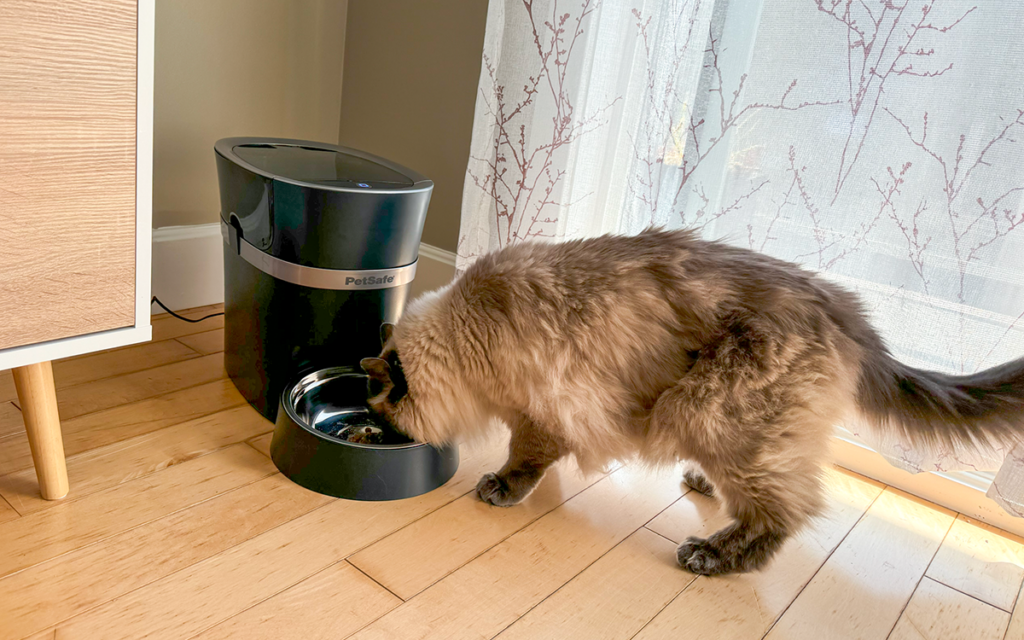

Milo has a habit I have been trying to solve for longer than I care to admit. When I am home and watching him, he eats at a reasonable pace. When I am not, or when his bowl refills all at once, he eats like he has somewhere important to be, finishes the entire portion in roughly forty seconds and then redeposits it on the kitchen floor about ten minutes later. Anyone who has stepped on cat vomit at midnight knows exactly what I am talking about. The PetSafe Smart Feed went on my list the moment I read about the slow feed function.
That feature alone would have gotten my attention, but the feeder is a more complete package than that. Pet Innovation Award winner, Wi-Fi connected, app-controlled via the My PetSafe app, Alexa-enabled, 24-cup capacity and food level notifications sent directly to your phone. I tested it with Milo over several weeks, including stretches where I was traveling and the remote features got a genuine workout rather than just a demo run.
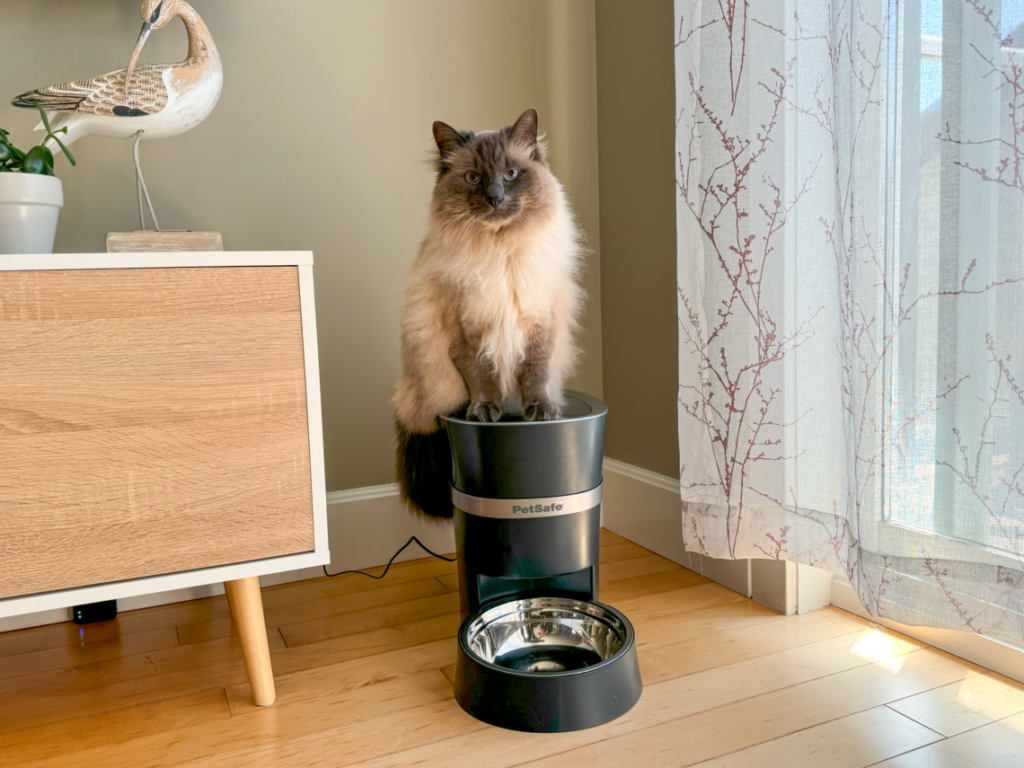
The short version: this feeder is well-built, the app works the way apps should and the slow feed feature solved the specific problem I bought it for. Milo has also developed a strong personal attachment to the top of the feeder as a napping surface, which introduced a design consideration I will get to. The quick-feed button placement is a choice I will never fully forgive.
Editor’s Note: Trusted Pet Review may earn a commission on qualifying purchases made through links in this post, at no extra cost to you. We only recommend products we’d genuinely consider for our own pets.
This feeder works with dry and semi-moist food only. It is not compatible with wet food. If your cat is on an exclusively wet food diet, this is not the right solution regardless of the other features.
The Pet Innovation Award-winning Smart Feed Automatic Pet Feeder keeps you connected to your pet, allowing you to schedule and adjust meals via the My PetSafe® app. With a 24-cup capacity, it dispenses dry and semi-moist food, featuring low and empty food sensors that notify your smartphone. Compatible with Amazon Dash Replenishment, it automatically reorders food when low. The feeder includes a stainless steel bowl and is dishwasher-safe for easy cleaning.
GUARANTEED BEST PRICE
USE COUPON CODE MEOW10 AT CHECKOUT TO GET $10 OFF
What the PetSafe Smart Feed Actually Is
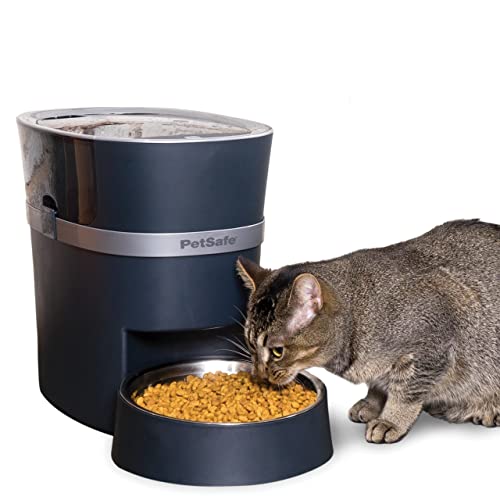
The PetSafe Smart Feed is a Wi-Fi-connected automatic feeder that holds up to 24 cups of dry or semi-moist food and links to the My PetSafe app on iOS and Android. From the app, you can schedule up to 12 meals per day, set portion sizes anywhere between 1/8 cup and 4 cups per feeding, trigger an immediate meal, check food levels and receive low-food and empty-hopper alerts. It integrates with Alexa for voice-controlled feeding, which is genuinely useful when your hands are full and your cat is making his hunger known from the other room.
The hardware is well-made. The bowl is stainless steel, the hopper and lid are BPA-free plastic and every part that contacts food is dishwasher-safe. A battery backup option using D batteries keeps scheduled feedings running during power outages, which becomes relevant very quickly the first time the power goes out at 6 AM and you realize your cat does not understand grid infrastructure.
The slow feed function is what drove the purchase. For any meal larger than 1/8 cup, the feeder dispenses food in small increments spread over 15 minutes instead of releasing the full portion at once. For Milo, this changes what happens after the meal in the most important way: the food stays down.
PetSafe Smart Feed at a Glance
Type | Wi-Fi connected automatic pet feeder; app-controlled |
Best For | Fast eaters, owners with irregular schedules, remote meal management |
Capacity | 24 cups (approximately 6 lbs of dry or semi-moist food) |
Portion Range | 1/8 cup to 4 cups per meal; up to 12 meals per day |
Connectivity | Wi-Fi (2.4 GHz); My PetSafe app on iOS and Android; Alexa-enabled |
Slow Feed | Dispenses meals over 15 minutes in small increments (any meal larger than 1/8 cup) |
Power Backup | Optional D battery backup for power outages |
Cleaning | Stainless steel bowl, BPA-free plastic hopper and lid; all dishwasher-safe |
Main Concern | No day-of-week schedule variation; loud dispensing; quick-feed button accessible to climbing cats |
Setup and App Experience
Getting It Running
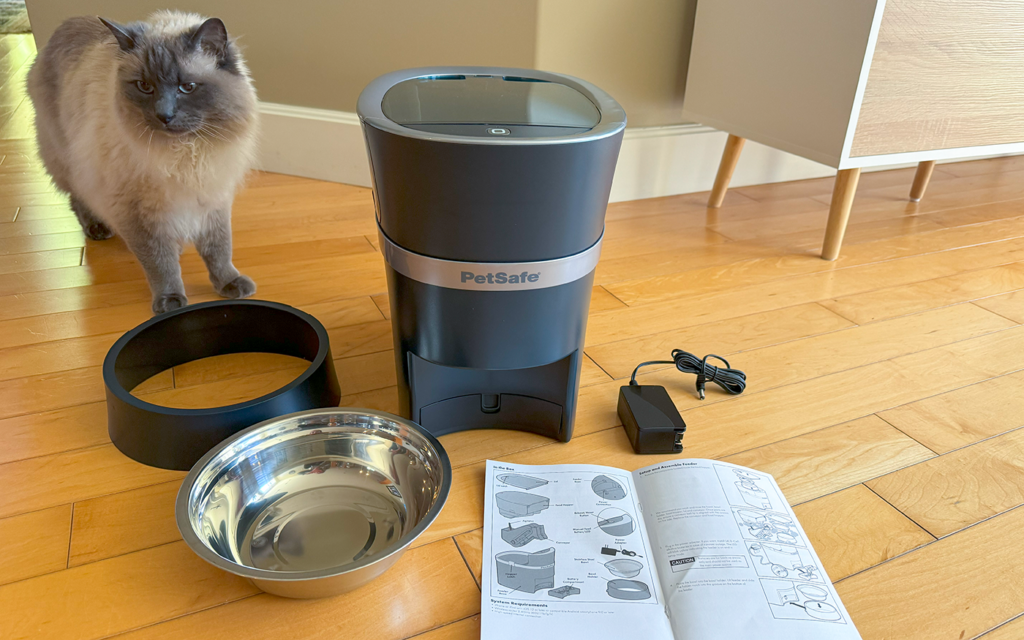
Out of the box, setup was fast. The feeder weighs about 8.75 pounds, light enough to carry easily, and the physical assembly is self-explanatory: fill the hopper, attach the bowl, plug it in. Connecting to Wi-Fi and linking to the My PetSafe app took under ten minutes including download time.
One practical note worth front-loading: the feeder requires a 2.4 GHz Wi-Fi connection. If your router runs dual-band (2.4 GHz and 5 GHz combined), make sure your phone is connected to the 2.4 GHz band during setup or the connection process will fail. It will look like a hardware or app problem. It is not. Switch bands first and try again before assuming something is broken.
The My PetSafe App
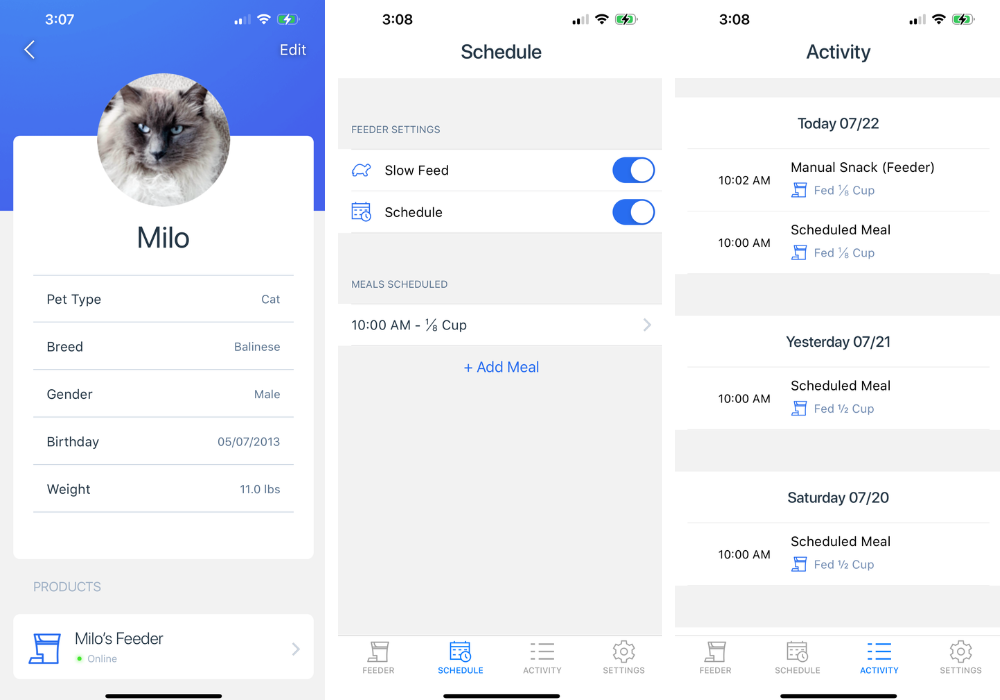
The app is more capable than most companion apps that ship with pet hardware. Setting a feeding schedule takes about two minutes: choose the time, choose the portion size, confirm. Notifications for low food and empty hopper arrive reliably and without the delay that makes some alert systems useless in practice. The instant feed button works without lag.
Portion history is logged and viewable, which is more useful than it sounds. Being able to check whether Milo actually ate during the day, rather than wondering from a distance and getting a full dramatic hunger performance when I walk in the door, changes the information available for managing his feeding.
Alexa integration works cleanly. A voice command delivers a meal without opening the app or locating the phone. During travel the feature is less relevant, but at home with occupied hands it earns its place in the setup.

Pro Tip
When you first enable the slow feed function, run a test cycle while you are home to watch how your cat responds. Some cats treat the gradual dispensing as a puzzle to solve aggressively, pawing the bowl or nudging the feeder. Milo watched it with intense suspicion for the first two days before accepting the arrangement. Knowing your cat’s reaction in advance lets you adjust placement or supervision before it becomes a habit.
Real-World Testing with Milo
The Slow Feed Function
This is the feature I bought the feeder for, and it delivered the most obvious real-world result.
Milo’s pattern before the Smart Feed: eat the full portion at a pace that suggested competing obligations, finish in under a minute, then revisit the bowl’s contents on the floor approximately ten minutes later. The slow feed function dispenses food in small drops spread across 15 minutes. He adjusted within a few days. He approaches when it starts, eats what comes out, wanders off and returns for the next increment. The floor stays clean. The problem is solved.
That outcome alone justifies the purchase for me. Everything else the feeder does well is a bonus on top of the thing I actually needed it to do.
Remote Feeding During Travel
The remote features got genuine testing during stretches away from home rather than just a demo run from the next room. Setting a schedule before leaving, adjusting it when plans shifted and monitoring food levels without calling someone to physically check all worked the way the product description says they should.
The instant feed option is more practically useful than it looks on a spec sheet. Being able to dispense an additional meal immediately, without waiting for the next scheduled time, covers the situations where a fixed schedule does not match what is actually happening. It shows up regularly in real use.
Food level notifications removed the low-grade uncertainty of extended trips. Knowing the hopper is still well-stocked without needing someone to confirm it is a small thing that eliminates a specific recurring concern.
- Slow feed function solves a real problem Dispenses meals over 15 minutes in small increments. For cats that bolt their food and immediately regret it, this is the feature the purchase lives or dies on. It works.
- App is genuinely reliable Scheduling, portion adjustment, instant feed and food level alerts all function without the lag or drop-out issues that plague lesser companion apps.
- 24-cup capacity means fewer refills Holds approximately 6 lbs of dry food. Practical for multi-day trips without relying entirely on a pet sitter for refills.
- Up to 12 meals per day with precise portions Portion sizes from 1/8 cup to 4 cups per meal. Supports everything from free-feeding approximations to strict medical portion protocols.
- Alexa integration works cleanly Voice-triggered feeding without opening the app. More useful at home than it sounds on the spec sheet.
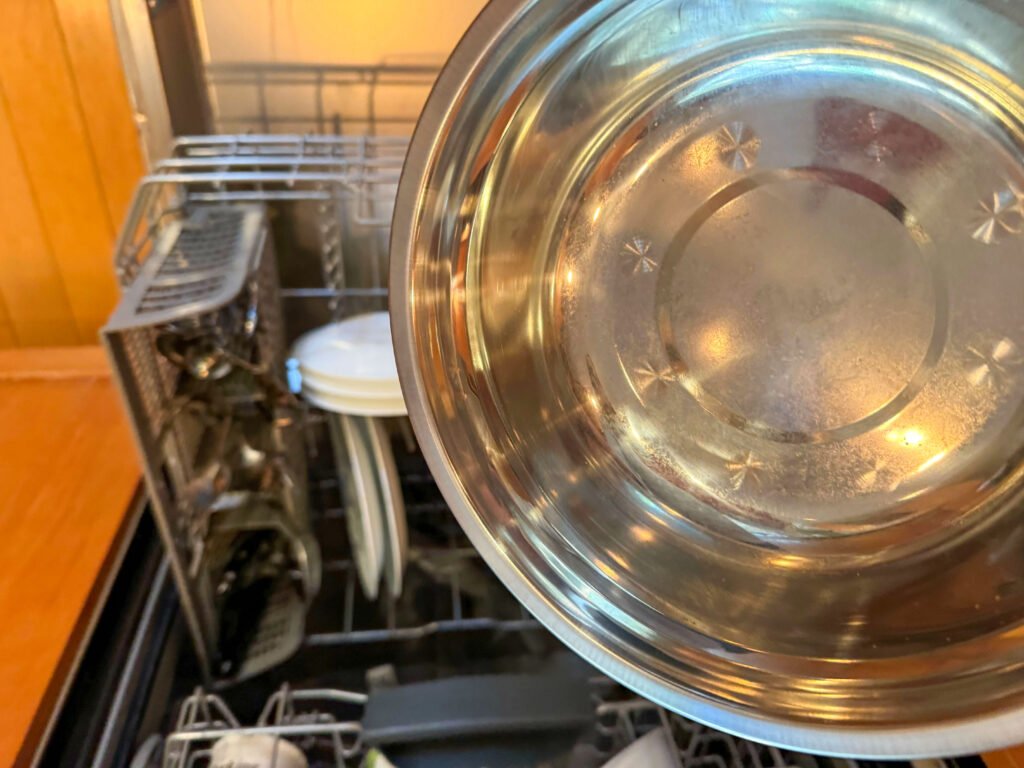
- Stainless steel bowl and dishwasher-safe components The parts that matter for hygiene are easy to clean and do not harbor bacteria the way plastic bowls do over time.
- Battery backup covers power outages Optional D battery backup keeps scheduled feedings running when the power goes out. Milo does not care about the reason; he cares about the meal time.
- No day-of-week schedule variation The feeder runs the same schedule every day. Weekend mornings, holidays, schedule changes: it does not know and does not care. This is a real gap in an otherwise capable system.
- Loud dispensing mechanism Noticeable in a quiet room, particularly for a scheduled 6 AM feeding near a bedroom. Placing a secondary bowl inside the steel bowl reduces it somewhat. Not a perfect fix.
- Quick-feed button on top is cat-accessible If your cat climbs on the feeder, and many will, the button is right there. Milo has triggered at least three unscheduled meals this way. He has no regrets.
- D battery replacement cost The backup batteries are useful but D batteries are among the more expensive formats. A recurring minor cost worth factoring in.
- Dry and semi-moist food only Not compatible with wet food. Non-negotiable limitation for cats on wet food diets.
The Design Quirks Worth Knowing
Three things that are real limitations, none of which changed my overall assessment but all of which are worth knowing before purchase.
The dispensing noise is noticeable. Not loud enough to wake a household, but present enough to announce the 6 AM feeding clearly in a quiet room. For setups near a bedroom this is worth thinking through. I have adapted. Milo finds the noise useful for pre-positioning himself in front of the bowl approximately four minutes before each scheduled meal time.
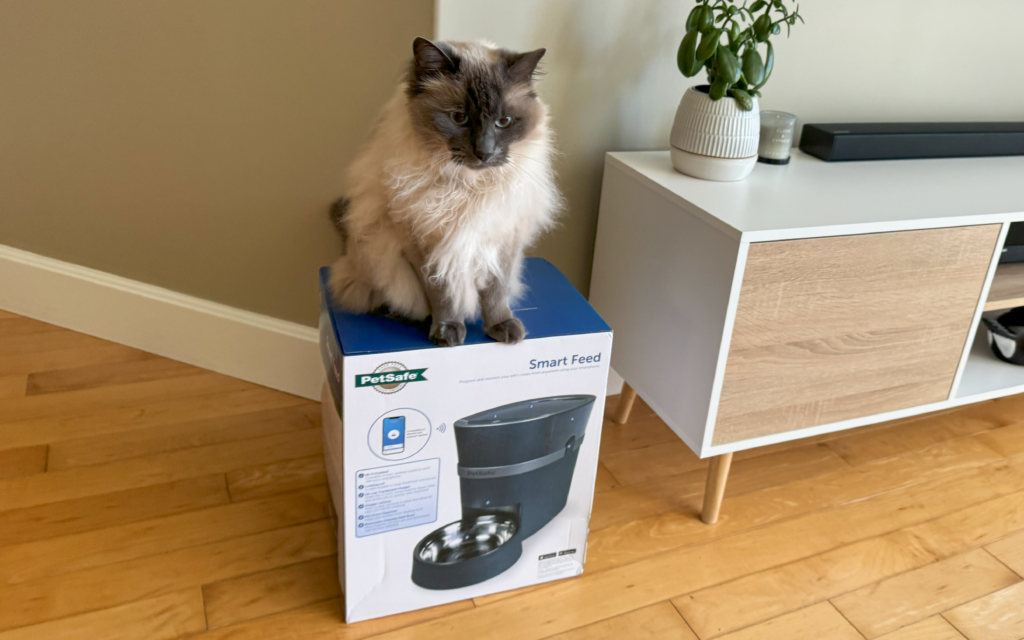
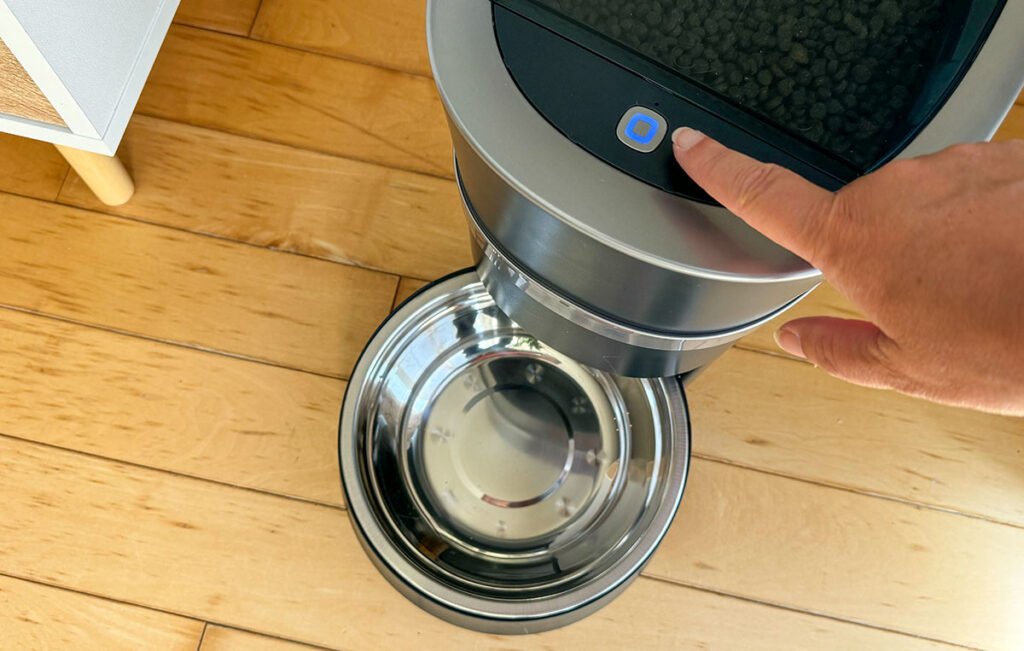
The quick-feed button is on top of the feeder. Milo treats the feeder as a reasonable surface for sitting, which means the button is accessible whenever he is up there. He has triggered at least three unscheduled meals this way. He has no regrets. A more protected button placement or a physical cover option would resolve this. Relocating the feeder to a surface he cannot access is the practical solution, which I eventually did.
Day-of-week schedule variation is not supported. The feeder runs the same schedule every day. Weekend mornings run later at my place and the feeder does not account for that. It is a genuine feature gap in an otherwise capable scheduling system, and it shows up every Saturday and Sunday.
What to Consider
Food compatibility is the most important thing to confirm before purchasing. The Smart Feed works with dry and semi-moist food only. Wet food is not compatible, full stop. For cats on exclusively wet food diets this feeder is the wrong product regardless of its other qualities.
The D battery backup is genuinely useful but D batteries are one of the more expensive battery formats. The cost per replacement is not large, but at regular intervals it adds up. Worth factoring into the total cost of ownership alongside the purchase price.
The 2.4 GHz Wi-Fi requirement is worth confirming against your home network setup before purchasing. Most modern routers handle this without issue, but if your network runs exclusively on 5 GHz, the feeder will not connect.
Who This Is Best For
Fast eaters with a vomiting habit. The slow feed function is the most practically solving-a-real-problem feature on this feeder. If bolt-and-vomit is a recurring issue, this is the direct solution. It worked for Milo and it is the reason this feeder is still in use months later.
Owners with unpredictable schedules. The app control, instant feed option and food level alerts are built for people whose days do not run on a fixed timetable. Remote meal management removes the friction of worrying about feeding windows when plans change unexpectedly.
Multi-meal feeding routines. Cats and dogs that do better on frequent small meals than on one or two larger portions benefit from the up-to-12-meals-per-day support. Portion sizes down to 1/8 cup make that approach practical without requiring anyone to be home for each feeding.
Owners who travel regularly. The remote features hold up under genuine travel conditions, not just at-home demos. Food level notifications, schedule adjustments and instant feed from anywhere reduce what needs to be delegated to a pet sitter.
The case is harder for cats on wet food diets (incompatible), households that need day-of-week schedule flexibility and owners looking for a budget entry-level option. The Smart Feed is a well-built mid-to-premium product priced accordingly. If the slow feed function is not a relevant need and the app control is not a priority, a less expensive feeder likely covers the requirements.
Frequently Asked Questions
Can an automatic feeder work for both cats and dogs?
Yes. Most app-connected automatic feeders with adjustable portion sizes support both cats and dogs. The portion range (1/8 cup to 4 cups per meal on this model) accommodates animals from small cats to larger dogs. For multi-pet households where animals eat different foods, separate feeders are the practical solution. For households where two animals share the same food, a single feeder with adjusted portion totals can work, though feeding competition at a shared bowl is a separate dynamic to manage.
How does the slow feed function work and which cats benefit from it most?
The slow feed function distributes meals larger than 1/8 cup in small increments dispensed over a 15-minute window rather than releasing the full portion at once. Cats that benefit most are those that eat very quickly and then vomit shortly after (a common pattern caused by rapid stomach distension), cats prone to obesity where meal pacing reduces caloric intake efficiency and cats with digestive sensitivities where large bolus intake causes discomfort. For cats that already eat slowly, the function adds no meaningful benefit.
What happens to scheduled feedings during a power outage?
Without backup power, an automatic feeder loses its schedule and cannot dispense meals during an outage. Models with a battery backup option maintain scheduled feedings on battery power until power is restored. The backup typically covers several days of normal feeding cycles depending on battery freshness and feeding frequency. For households where power outages are uncommon, the backup is a low-cost insurance option. For households with frequent outages, confirming backup duration against typical outage length is worth doing before relying on it.
Can two cats share the same automatic feeder?
Two cats can share a feeder bowl simultaneously if they eat the same food and feeding competition is not a problem between them. The practical limitations are portion accuracy (the feeder dispenses a combined total rather than individual amounts) and the social dynamics at a single feeding station. For cats with different dietary needs or significant size differences affecting portion requirements, separate feeders with individual schedules are the cleaner solution. Accessories like a two-bowl meal splitter can help with the physical separation while maintaining a single feeding station.
Does an automatic feeder work with wet food?
Most automatic feeders, including gravity and auger-based models, are designed for dry or semi-moist food only. Wet food clogs mechanical dispensing systems, spoils quickly at room temperature and does not flow through the portion mechanisms reliably. Specialized automatic feeders designed for wet food exist as a separate product category; they use timed tray rotation or sealed compartment systems rather than hoppers. Confirm food compatibility before purchasing any automatic feeder if wet food is part of the diet.
How do I know when the feeder is running low on food?
App-connected feeders with food level sensors send push notifications to the linked smartphone when the hopper reaches a low threshold and again when it is empty. The reliability of these alerts depends on the sensor design and app connection stability. For travel use specifically, confirming that notifications are arriving reliably during normal operation before leaving for an extended period is a reasonable precaution. A feeder that alerts you at home consistently is one you can trust to alert you from a distance.
Is app control for a pet feeder actually reliable enough to depend on while traveling?
App-controlled feeders have improved significantly in connection reliability over the past few years. The practical requirement is a stable home Wi-Fi connection that remains active while you are away and a smartphone with a reliable data connection on your end. Most failures in remote pet feeder management trace back to home network issues (router restarts, ISP outages) rather than the feeder hardware or app itself. A scheduled feeding via the app that fails because the home router restarted is indistinguishable from an app failure. Testing the remote connection before an extended trip and confirming a backup plan (a neighbor or pet sitter who can manually feed if needed) covers the edge cases.
Final Verdict
I bought this feeder to solve one problem: Milo eating too fast. It solved that problem. Everything else came alongside the core feature and held up under real use.
The three limitations are genuine: no day-of-week schedule variation, a loud dispensing mechanism and a button that rewards cats who treat the feeder as furniture. None of them changed my overall assessment. They are worth knowing going in so the experience matches the expectation.
I have been using it for several months now and my relationship with it has moved well past testing into genuine dependence. On weekends when I head up to the lake, it is the thing that makes leaving straightforward. The schedule runs, the alerts come through and Milo gets fed on time without any intervention from me. That kind of reliability is not something you take for granted once you have it.
For anyone whose cat has a speed-eating habit and an owner with an irregular schedule, this is a very good feeder. The app works, the hardware holds up and the slow feed function does exactly what it claims to do. Milo has been using it for months and has developed what I can only describe as a scheduling dependency. He positions himself in front of the feeder approximately four minutes before each programmed meal time. Picky cats, it turns out, adapt quickly when the food is reliable.
The Pet Innovation Award-winning Smart Feed Automatic Pet Feeder keeps you connected to your pet, allowing you to schedule and adjust meals via the My PetSafe® app. With a 24-cup capacity, it dispenses dry and semi-moist food, featuring low and empty food sensors that notify your smartphone. Compatible with Amazon Dash Replenishment, it automatically reorders food when low. The feeder includes a stainless steel bowl and is dishwasher-safe for easy cleaning.
GUARANTEED BEST PRICE
USE COUPON CODE MEOW10 AT CHECKOUT TO GET $10 OFF


