


There is a specific kind of stress that comes with a pet who seems slightly off. Not bleeding, not collapsed, just not quite right. The eye looks a little gunky. The limp shows up and then disappears. You know you should probably do something, but you are not sure the something is worth a 300 dollar visit and an afternoon wrestling a carrier.
So you do what most people do. You open a search bar, or lately you ask an AI, and twenty minutes later you have talked yourself into something rare and terrible. The guessing is the worst part.
This guide gives you a faster way to decide. In about 60 seconds you can tell whether your pet’s problem belongs at the emergency vet, at your regular vet, or with an online vet you can talk to from your couch.
Editor’s Note: Trusted Pet Review may earn a commission on qualifying purchases made through links in this post, at no extra cost to you. We only recommend products we’d genuinely consider for our own pets.
A 60-second way to stop guessing, and to stop paying emergency prices for problems that never needed them.
The Three Places Pet Care Actually Happens
Almost every pet problem belongs in one of three lanes. The mistake most owners make is treating all three as the same decision, then defaulting to the most expensive option out of guilt or the cheapest out of avoidance.
The lanes are simple once you see them. Emergencies need care in minutes or hours. Some problems need a vet’s hands and eyes but can wait a day or two. And a long list of mild, routine, is-this-normal questions mostly need a trained opinion, not a physical exam. That last group is where telehealth earns its place.
Start Here: The 60-Second Triage
Answer two quick questions and you'll know whether your pet's problem belongs at the emergency vet, your regular vet, or an online vet you can use from home. When in doubt, always choose the more cautious option.
Is your pet showing any of these right now?
- Trouble breathing, choking, or pale or blue gums
- Collapse, a seizure, or unresponsive
- A male cat straining to pee with nothing coming out
- A swollen, hard belly with unproductive retching (dogs)
- Suspected poisoning, or swallowed something dangerous
- Heavy bleeding, major trauma, or signs of heatstroke
When you're unsure at this level, go now. No app replaces an emergency room.
Does your pet have any of these?
- Limping, or won't put weight on a leg
- A wound that may need stitches
- Not eating for 24 hours or more (especially cats)
- Vomiting or diarrhea lasting past 24 hours
- Ongoing pain, or a new lump you want checked
This needs an emergency vet
Based on what you selected, your pet needs in-person emergency care right away. Call your nearest emergency vet or animal hospital and head there now. An online vet is not the right tool for this.
If you are not sure how serious it is, it is always safer to be sent home from the ER than to wait too long.
Book your regular vet
This needs a hands-on exam, but it is usually not an emergency. Call your regular vet and aim to be seen in the next day or two.
If anything gets worse quickly, treat it as an emergency and go in right away.
An online vet is a good fit
This is the kind of mild or routine issue an online vet can handle from home, often the same day, without the cost and chaos of a clinic visit.
An online vet can advise you no matter where you live. Whether they can prescribe medication depends on your state.
This tool is a guide, not medical advice. When you are unsure, always escalate to in-person care.
What an Online Vet Can and Can't Do
Handles well • Advice on mild or routine problems • Triage: deciding if you need to go in • Refills and ongoing condition check-ins • Diet, behavior, and prevention questions • Prescriptions, where your state allows | Can’t replace • Bloodwork, x-rays, or imaging • Anything hands-on, like a deep wound • True emergencies and urgent pain • Care for exotics, birds, or reptiles • Your regular vet for the big stuff |
Why We'd Point You to Dutch
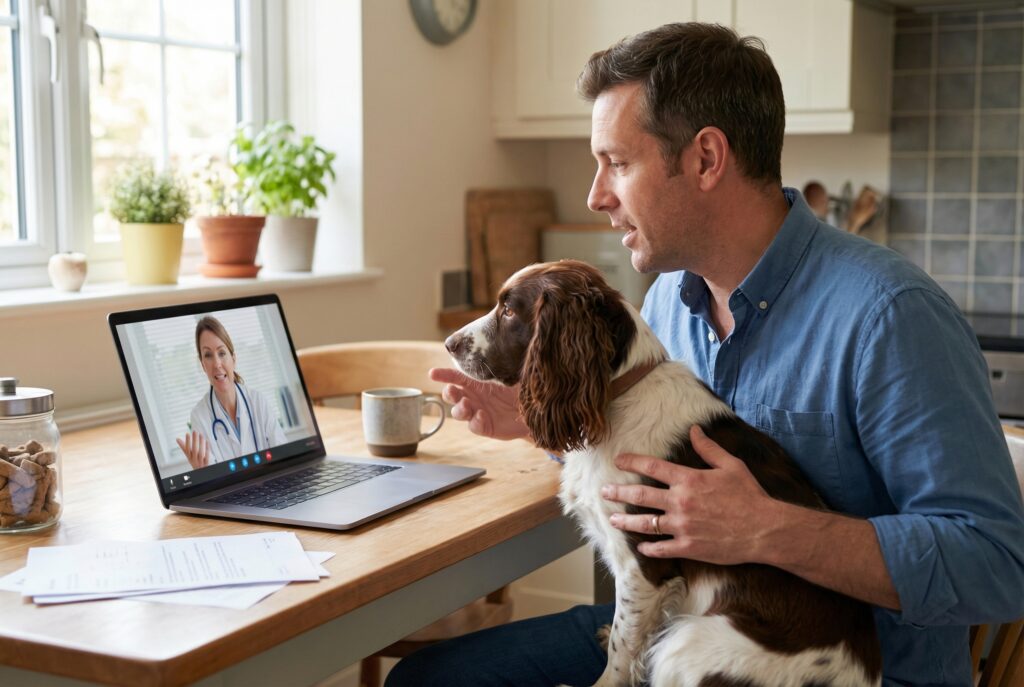
For the telehealth lane, Dutch is one of the most complete options. It’s built for dogs and cats, connects you with a licensed vet by video (often same day), and one flat monthly fee covers the whole household instead of charging per visit. It shines on the everyday stuff: allergies, itchy skin, anxiety, flea and tick, diet questions, and refills, with prescriptions sent to your door where your state allows.
Two honest caveats: whether a vet can prescribe depends on your state, and the pharmacy side can run slow, so it’s not for anything time-sensitive. For the gray-zone middle of pet care, though, it’s a genuinely useful tool to keep in your pocket.
- Choose it if you want on-demand vet access for routine stuff without a per-visit bill.
- Skip it if your pet needs hands-on care or a prescription your state requires an exam for.
Dutch offers ongoing telehealth care for dogs, not just quick advice. You’ll get personalized treatment plans from licensed vets and, in many cases, prescriptions delivered to your door. Ideal for managing chronic issues like allergies, anxiety, and skin conditions without constant in-person visits.
LIMITED TIME OFFER
SAVE 32% OFF MEMBERSHIP WITH TECHNOBARK32
+ GET $25 CREDIT FOR PREVENTATIVE ESSENTIALS

Does Your State Allow Prescriptions?
A video visit with an online vet is available in nearly every state. The prescription is the part that varies. Some states let a vet examine your pet over video and prescribe from there. Others require an in-person exam first, and a few cap how long a virtual prescription lasts before your pet needs to be seen. It is worth thirty seconds to check yours before you count on medication showing up at your door.
The rules change often, and no two trackers agree on an exact number, so any fixed list goes out of date fast. The reliable way to find out is to check at the source: when you start a Dutch registration, you pick your state and it tells you right away whether prescriptions are available where you live. If they are not, you still get unlimited video advice, preventive care guidance, and over-the-counter recommendations. You just cannot have a prescription filled through the service.
A few things worth knowing as you check:
- In most states, a vet can start care over video and prescribe when it is appropriate.
- A minority of states still require an in-person exam before any prescription.
- Some states that allow virtual prescribing limit it. Florida, for example, caps a virtual prescription at about two weeks of most medications before your pet has to be seen in person.
- Controlled substances almost always require an in-person visit, no matter where you live.
If your state is on the stricter side, an online vet is still useful for triage, advice, and deciding whether an in-person trip is even needed. You just plan on your regular vet for the prescription itself.
The Mistake to Avoid
The common error is letting emotion pick the lane. Guilt pushes people to the ER for things that could wait. Avoidance and cost push people to ignore a limp that needed an exam. The fix is boring and reliable: match the response to the signs, and escalate the moment you are unsure. Telehealth is not there to replace your vet. It is there to take the long middle of pet ownership off your plate.
Lorem ipsum dolor sit amet, consectetur adipiscing elit. Ut elit tellus, luctus nec ullamcorper mattis, pulvinar dapibus leo.
FAQ
How do I know if my pet’s problem is a real emergency?
If your pet is struggling to breathe, has collapsed, is bleeding heavily, cannot urinate, or may have been poisoned, treat it as an emergency and go in. When in doubt, escalate. It is always safer to be sent home from the ER than to wait too long.
Can an online vet actually diagnose my pet?
For many visible or describable issues, yes. A vet can assess what they can see on video and what you describe, then recommend a plan. They cannot run bloodwork or imaging, so anything that needs lab tests or hands-on examination will get referred to an in-person visit.
Can a telehealth vet prescribe medication?
Sometimes. It depends on your state. Some states allow a vet to start care and prescribe over video, while others require an in-person exam first. The video advice is available everywhere, but the prescription is the part that varies.
Is telehealth safe for my pet?
Yes, for the right problems. The risk is not the technology, it is using it for something that actually needed hands-on care. Used for mild and routine issues, and as a triage step, it is a safe and useful tool.
Does telehealth work for every kind of pet?
Most services are built for dogs and cats. Exotics, birds, and reptiles usually need a specialist in person, so telehealth is not the right fit for them.
Is it cheaper than a regular vet visit?
For routine questions, usually. A flat monthly membership often costs less than a single in-person visit, which can run 200 to 300 dollars. It is not a substitute for in-person care when your pet truly needs it, but it does stop the small stuff from becoming a big bill.
Final Thoughts
Three lanes, one rule: match the response to the signs, and escalate when you are not sure. Use the emergency vet for the true emergencies. Use your regular vet when something needs hands and eyes. Use telehealth for the long list of mild, routine, is-this-normal moments that do not justify the cost and chaos of a visit.
The goal was never to avoid the vet. It is to stop guessing, and to spend your worry where it actually matters.


