


Every mutt owner has fielded the question. At the park, at the vet, from a stranger leaning a little too far into the dog’s personal space: “Aw, what is he?” And every mutt owner has given the same answer, delivered with a confident shrug. “Lab mix, we think? Maybe some shepherd in there? Honestly, your guess is as good as ours.”
Here is the fun part. That guess is probably wrong, and so is everyone else’s, because the thing people judge a mutt by, the face, the ears, the coat, is the single least reliable clue there is. This quiz throws all of it out. It never asks what the dog looks like. It asks how he behaves, then hands back its best read on the breeds hiding under the hood. Eight questions, sixty seconds, one slightly addictive result you will want to text to someone.
It is built to be fun first. There is a reason it tells you whether your gut was right or whether you are in for a plot twist. But there is a useful idea sitting underneath the game: a dog’s behavior is a louder clue to his ancestry than his haircut, and knowing what is actually in there can change how you exercise him, train him and even keep him safe at the vet. More on that after the quiz. First, the mystery.
Editor’s Note: Trusted Pet Review may earn a commission on qualifying purchases made through links in this post, at no extra cost to you. We only recommend products we’d genuinely consider for our own pets.
Knowing what is in your mutt is not just party trivia. It can reshape how you train him, exercise him and keep him safe at the vet.
Why Your Eyes Are Lying to You
The reason mutt guesses go wrong so often is simple: dogs do not wear their genetics on the outside.
A medium brown dog with a curled tail and a blocky head could be hiding herding breed, hound, terrier, or a whole committee of all three. Looks blend in unpredictable ways, and one or two visible traits can come from a breed that barely registers in the actual DNA. It is why even shelter staff and vets, people who see hundreds of dogs a year, regularly call a mutt’s main breed wrong from looks alone. The test comes back and the room goes quiet.
Behavior is the sturdier tell. Breeds were shaped for jobs, and those jobs left fingerprints: the herder who circles the kids at a barbecue, the hound who goes gloriously deaf the second a scent appears, the self-appointed head of doorbell security. Those instincts survive the blender of mixed breeding far better than a particular ear shape does. That is the bet this quiz makes. Tell it how your dog acts, and it works backward to the jobs his ancestors were built for.
How the Quiz Reads Your Dog
The quiz works the way a good guess does, by stacking up small tells until a pattern shows.
It opens by asking for your hunch: what you figure your mutt is, mostly. That is on purpose. It wants your guess on the record so it can tell you later whether your instincts were sharp or hilariously off.
Then come eight questions about behavior, and not one of them cares about appearance. How does he handle a dropped piece of chicken? What happens when the doorbell rings? Where does the squirrel chase end, in your arms or in the next county? Each answer nudges the score toward one or more of thirteen personality types.
What comes back is not a single label but a blend: your dog’s top three archetypes, ranked by percentage, with the one behavior that gave him away most because almost no mutt is just one thing, and the fun is in the mix.
Start Here: 60-Second Dog Breed Quiz
Answer eight quick questions about how your dog actually behaves, and we'll give you our best read on the breeds hiding in your mutt. We won't even ask what they look like. That's the part that fools everyone.
Worth remembering: personality is shaped by upbringing and life, not just genes. Two dogs with identical DNA can act nothing alike.
Here's the wild part: studies have found that even shelter staff and vets often misjudge a mutt's main breed from looks alone. The DNA regularly tells a different story.
A cheek swab is the only way to truly settle it. Embark reads hundreds of dog breeds, plus health risks and ancestry, and gives you the real breakdown.
See what Embark revealsJust for fun. This is a personality quiz, not a DNA test or veterinary advice. Every dog is an individual, and the only way to truly know a mutt's makeup is genetic testing.
Meet the 13 (a Quick Roll-Call)
Every result is built from the same cast of thirteen. Here is the lineup, and odds are you already know which one is asleep on your couch right now.
- Herding Hustler. Border Collie, Aussie, Heeler. A four-legged middle manager who needs a job, a purpose and ideally a flock to run. Your family counts.
- Eternal Retriever. Lab, Golden. Perpetually delighted and perpetually hungry, convinced every human is a friend he simply has not met yet.
- Gun-Dog Gentleman. Pointer, Setter, Vizsla, Spaniel. A sensitive athlete with a birdy brain who runs big, feels everything and wants to be wherever you are.
- The Nose Knows. Beagle, Coonhound, Basset. Led entirely by the nose, gloriously stubborn and powered mainly by snacks.
- Sighthound Soul. Greyhound, Whippet. A 30-second sprinter and a 20-hour napper, elegant and ready to chase anything that bolts.
- Tiny Tornado. Jack Russell, Rat Terrier. Maximum dog per pound, and he has never once considered quitting.
- Bully Heart. Pit-type, Boxer, Bulldog. A muscle-bound marshmallow who leans his full weight on you and is genuinely shocked he is not a lap dog.
- Northern Spirit. Husky, Malamute, Shiba. Stunning, vocal and convinced the rules are more of a suggestion. Loves you fiercely, strictly on his terms.
- Velvet Guardian. Rottweiler, Doberman, German Shepherd. Watchful and devoted, aloof with strangers and a total softie with his people.
- Flock Guardian. Great Pyrenees, Anatolian. An independent night-shift supervisor, calm and deeply suspicious of any 3 a.m. noise.
- Working Brain. Poodle, Schnauzer, doodle mixes. Scary-smart and faintly manipulative. If you are not training them, rest assured, they are training you.
- Couch Diplomat. Cavalier, Frenchie, Chihuahua. Big personality, small footprint and strong opinions about the doorbell.
- Free Spirit. The village dog, the true mystery mutt. The original uncopyable design: resourceful, adaptable and entirely his own breed.
Most dogs are two or three of these wearing a single coat. That overlap is the whole point of the blend, and the reason your result reads like a recipe instead of a label.
From Fun Guesses to Real Answers
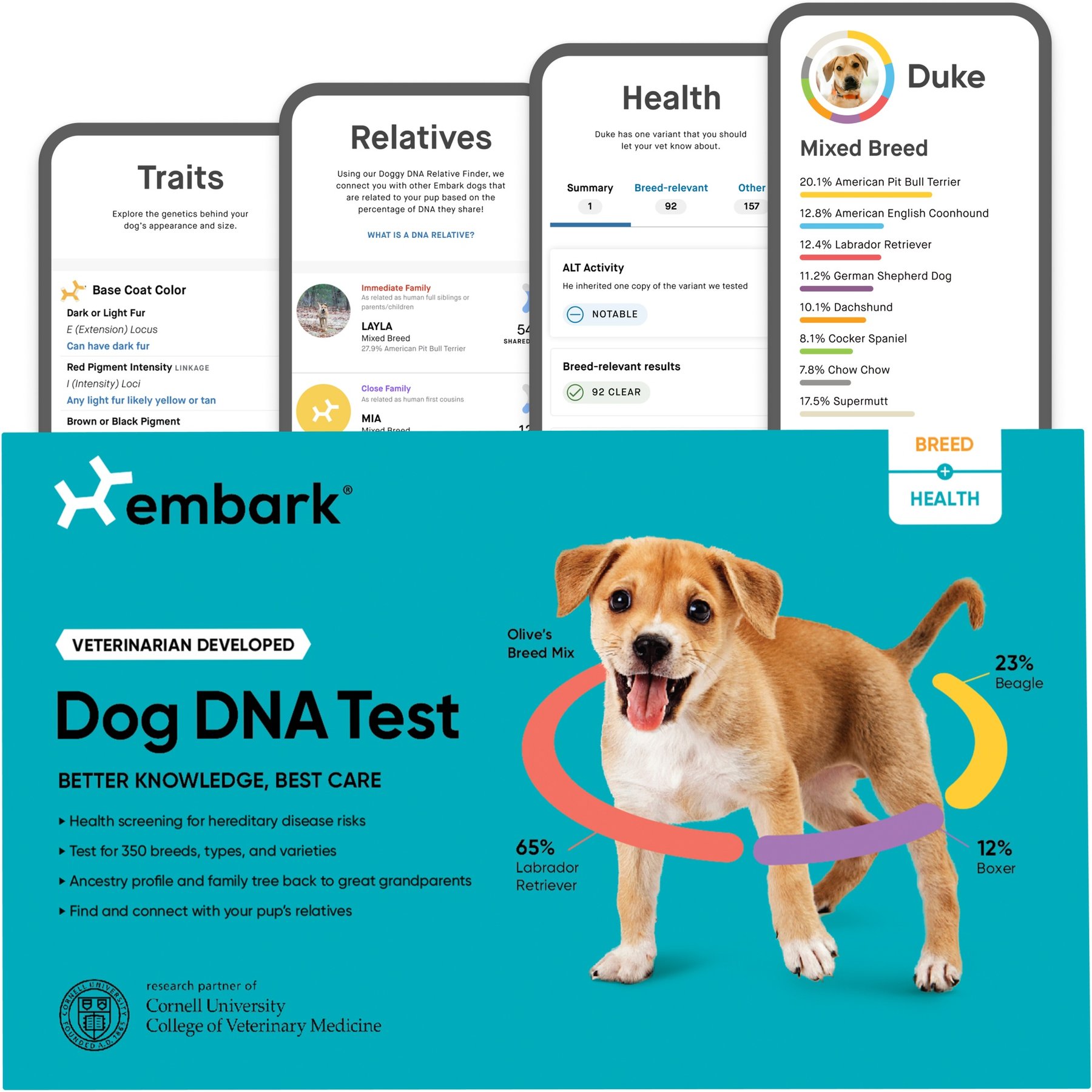
The quiz is a smart guess, not a verdict. It reads behavior, and behavior is shaped by upbringing as much as genes, which is exactly why two dogs with identical DNA can turn out nothing alike. So here is the honest version: the quiz gives a strong read, and a cheek swab settles the argument. That is where a dog DNA test like Embark comes in. It reads hundreds of breeds from a bit of saliva and tells you what is really in the mix.
And knowing the mix is not just trivia for the group chat. It can change real decisions:
- It can keep him safe at the vet. Many herding breeds carry a gene called MDR1 that makes some everyday drugs, certain dewormers, sedatives and anti-diarrhea meds, dangerous at normal doses. A dog can look nothing like a Collie and still carry it. If a test flags herding ancestry, that is a heads-up worth handing your vet before the next procedure, not after.
- It explains the “problem” behavior. A dog who shreds the house when left alone may not be badly behaved. He may be most of the way to a working breed with nothing to do. That reframes the fix from punishment to a proper job.
- It sets the exercise bar honestly. A secret sighthound wants short sprints and long naps. A hidden husky wants a fence built like a prison yard. Guessing wrong here is how good dogs get labeled difficult.
- It guides the body stuff. Retriever-heavy mixes pile on weight if you let them. Flat-faced ancestry changes how a dog handles heat. Breed makeup is a quiet input into diet, and into what your vet keeps an eye on as he ages.
- It comes with a health screen. Beyond breed, tests like Embark screen for a long list of genetic conditions, so you can monitor for what your specific dog is actually predisposed to instead of waiting to be surprised.
None of that requires you to care even slightly about pedigree. It is just the difference between managing the dog you imagine you have and the one who actually showed up.
The Embark Breed + Health DNA Test does more than tell you your dog’s breed mix—it screens for 270+ genetic health conditions and offers detailed insights into traits, ancestry, and even potential relatives. Results are clear, thorough, and backed by veterinary research. If you want more than a fun guess at your dog’s background (and actually useful health info), this test is one of the most comprehensive options out there.

Pro Tip
If your mutt turns out to carry herding breed, even a little, ask your vet about the MDR1 gene before the next sedation, dewormer or surgery. Dogs with this mutation can react badly to drugs that are perfectly safe for other dogs, and plenty of carriers look nothing like a herding breed. It is a one-time thing to learn and a genuinely dangerous thing to discover the hard way.
Frequently Asked Questions
Can a quiz really tell what breed my dog is?
Not exactly, and any quiz that promises certainty is overselling. A behavior quiz makes an educated guess by matching how your dog acts to the jobs different breeds were built for. It is a strong, fun starting point, but only a DNA test can confirm the actual breeds.
Why does my dog’s behavior matter more than how he looks?
Because looks are a weak signal in a mixed breed. A single gene can shape a dog’s coat or ears while the rest of the DNA points somewhere else entirely. Behavior, the drive to herd, hunt, guard or nap, tends to carry through a mix more reliably than appearance does.
How accurate are dog DNA tests?
The good ones are quite accurate for breed identification, and improving every year as their reference databases grow. They compare your dog’s DNA against hundreds of known breeds. No test is flawless, but a lab result is far closer to the truth than a guess from a photo.
My rescue’s paperwork already lists a breed. Is that reliable?
Treat it as a friendly guess, not a fact. Shelter and rescue breed labels are usually based on appearance, which is exactly the clue that fools people most. Plenty of owners are surprised when a DNA test comes back with breeds the paperwork never mentioned.
Does knowing the breed actually change anything?
It can change quite a lot. Breed makeup hints at how much exercise a dog needs, how he is likely to learn, what health issues to watch for and even which medications deserve a second look. It turns guesswork into a plan.
If two dogs are the same breed mix, will they act the same?
Not necessarily. Genes load the dice, but upbringing, training and plain individual personality roll them. This is why two dogs with nearly identical DNA can have completely different temperaments, and why a breed read explains tendencies rather than guarantees.
Is a mixed breed dog healthier than a purebred?
Often, but not automatically. A wider gene pool can lower the odds of some inherited conditions, which is the grain of truth behind hybrid vigor. Mixes can still inherit breed-linked issues, though, so knowing what is in the mix helps you watch for the right things.
Final Thoughts
Here is the quiet truth the whole quiz is built on: a mutt is not a watered-down version of a real breed. He is his own thing.
The fun of guessing what is in there never really gets old, partly because the answer is so often a surprise. The goofy one turns out to be part guardian. The dignified one is secretly half terrier. The blend is the personality, and no shelter label or street-corner guess captures it the way living with the dog does.
So take the guess for what it is, a great party trick and a real conversation starter. Then, if curiosity gets the better of you, let the science settle it. Knowing the breeds is not about putting your dog in a box. It is about understanding the one you already love a little better, and giving him a life that fits who he actually is.
Whatever the quiz says, the best breed in the house is still the one currently stealing your spot on the couch.


